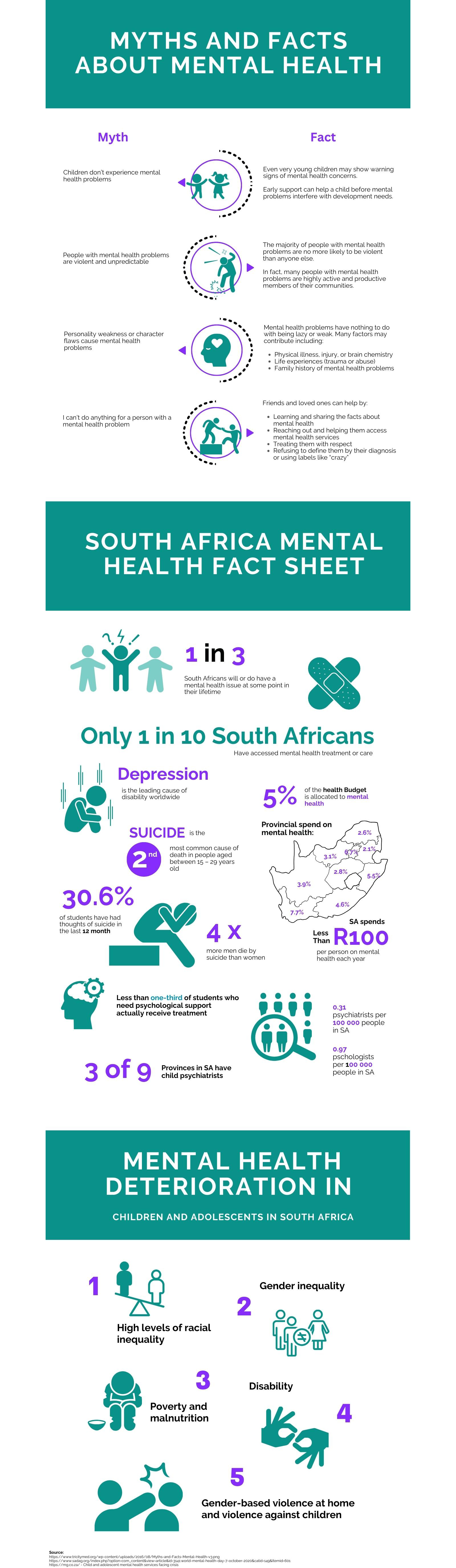





Explaining some mental health conditions
Helping parents and teachers understand certain mental health conditions. Learning about mental health is crucial for us all to imagine a better future for everyone.
I had a black dog, his name was depression At its worst, depression can be a frightening, debilitating condition. Millions of people around the world live with depression. Many of these individuals and their families are afraid to talk about their struggles, and don't know where to turn for help. However, depression is largely preventable and treatable. Recognizing depression and seeking help is the first and most critical towards recovery.
What is ADHD? There are different types of ADHD: inattentive, hyperactive/impulsive, and combined. ADHD impacts kids, teenagers, and adults but is treatable with the help of professionals.
Borderline Personality Disorder Explained Borderline Personality Disorder (also known as Emotionally Unstable Personality Disorder), is characterised by strong emotional responses, unstable relationships and a disturbed sense of self. In this video we cover the symptoms (including DSM 5 diagnostic criteria) as well as potential causes, and treatment.
Understanding Autism Autism is a spectrum. This means everybody with autism is different. Some autistic people need little or no support. Others may need help from a parent or carer every day. Being autistic does not mean you have an illness or disease. It means your brain works in a different way from other people..
Sadness vs Depression
Child Depression Ages 6-12 -The whole child.

“About 5 percent of children and adolescents in the general population suffer from depression at any given point in time. Children under stress, who experience loss, or who have attention problems, learning, conduct or anxiety disorders are at a higher risk for depression. Depression also tends to run in families.”
Ages 6-12
What to do?
Emotion Coaching: One of the Most Important Parenting Practices in the History of the Universe

Christine Carter | March 19, 2009 This first step to coping with negative emotions (in yourself, your children, or in your mother-in-law) is to figure out what they are feeling and to accept those feelings. Even if we don’t accept the bad behavior that often accompanies negative emotions, we still want to send the message that all feelings are okay, even the worst ones.
Ages 6-12
- What Does It Mean If Your Child Is Sensitive?
- The Importance of Healthy Parent-Child Relationships
- Healthy Parent-Child Relationships
- Attention Deficit Hyperactivity Disorder
Did you know?
SADAG Appointed By Facebook To Help Prevent South African Suicides

Facebook has incorporated suicide prevention tools into its platform, and SADAG will be facilitating the South African service. The social network has introduced mechanisms and processes to make it easier for people to help friends who post messages about suicide or self-harm. Says Callison-Burch: “In instances when someone posts distressing content about self-injury or suicide, we want to be sure that friends and family members have access to tools and information to provide.
Online assessments
Adapted from: Lovibond, P.F. & Lovibond, S.H. (1995). The structure of negative emaotional states: Comparison of the Depression Anxiety Stress Scales (DASS) with the Beck Depression and Anxiety and Inventories.” Behaviour Research and Therapy, 33, 335-342.